What Is a Black Aura? Meaning, History, and Limits
This post may contain affiliate links. We may earn a small commission from purchases made through them, at no additional cost to you.
A black aura does not have one fixed meaning because aura interpretations depend on the reader, tradition, and context. Modern spiritual accounts connect it with ideas ranging from grief and exhaustion to protection and introspection, but none of these readings can diagnose a personality or condition. Understanding the history and limits of the idea can help you respond with curiosity instead of fear.
What Does a Black Aura Mean?
Across several modern spiritual accounts, a black aura is variously interpreted as a sign of negativity, grief, exhaustion, protection, or inward reflection. These are spiritual interpretations, not standardized facts. Different readers may look at the same supposed aura and reach opposing conclusions.
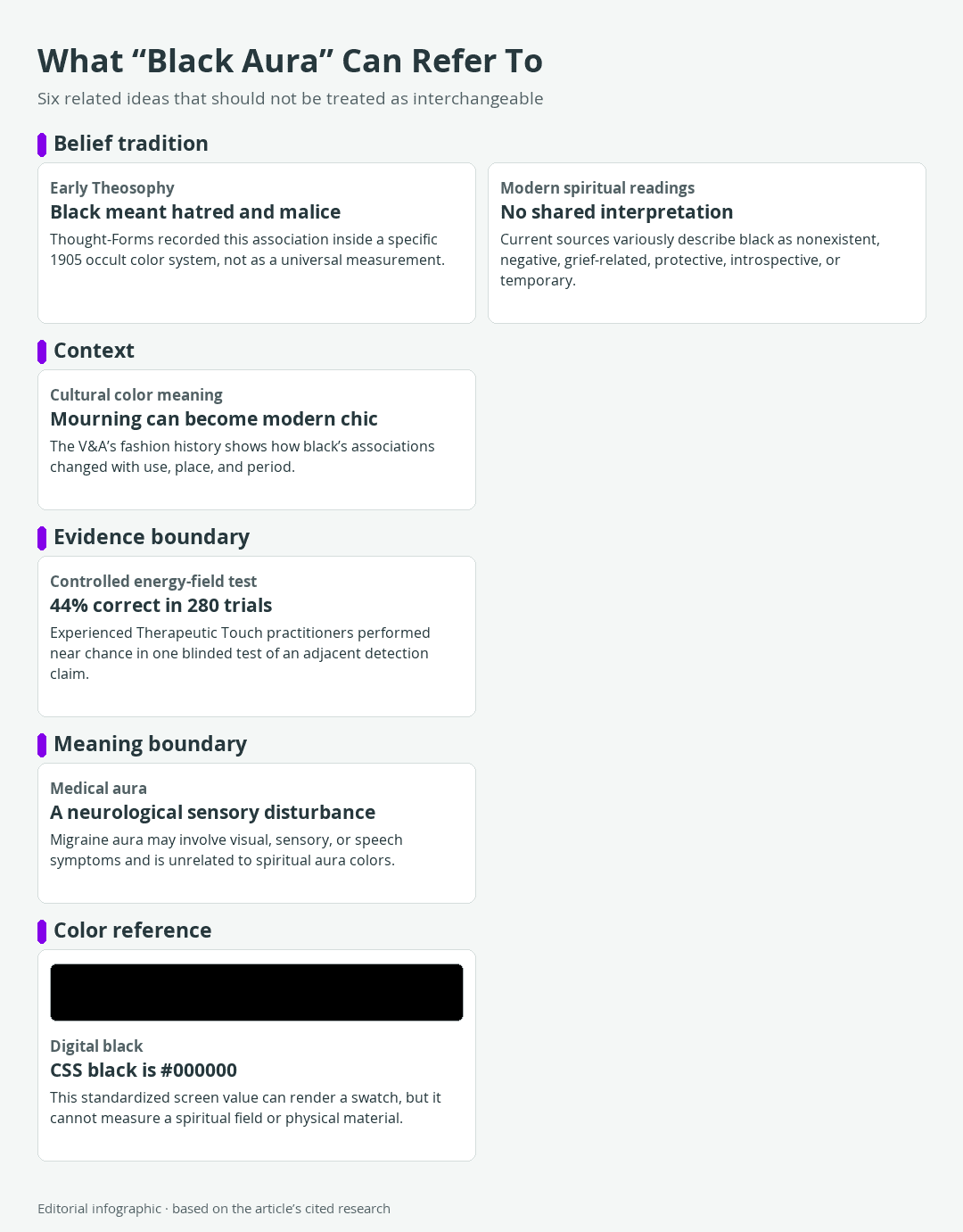
Download the complete color reference sheet (PNG): What “Black Aura” Can Refer To (PNG)
Most importantly, a claimed black aura does not show that someone is evil, dangerous, depressed, traumatized, or physically ill. An aura reading cannot establish a person’s character, mental health, or medical condition.
The short answer
The phrase “black aura” belongs to an interpretive belief system in which colors around a person are thought to reflect thoughts, emotions, or energy. Some practitioners use black as a negative symbol. Others understand it as a protective boundary, a period of grief, a need for rest, or a temporary retreat from the outside world. Still others distinguish a genuinely black aura from dark gray, muddy, or dim colors.
That disagreement matters. These modern accounts do not use a shared definition or method. Even within spiritual practice, a reading should therefore be treated as one person’s interpretation rather than a verdict. Our broader guide to aura colors and their proposed meanings provides context for the wider belief system.
Black as a digital color reference
The standardized CSS screen color named black is shown below. Its HEX value controls the RGB values and visible swatch, but it is only a digital reference. It is not a measurement of spiritual energy, a sample of paint or pigment, or evidence that an aura has this precise appearance.
| Name | HEX | RGB | Color |
|---|---|---|---|
| Black | #000000 | 0, 0, 0 |
In sRGB, #000000 sets the encoded red, green, and blue channels to zero. That digital value does not describe how a physical paint mixture will behave. If your goal is artistic rather than spiritual, a guide to mixing black paint addresses that separate material question.
Where the Black Aura Idea Came From
Claims about colored spiritual fields have appeared in more than one setting, but a major route into Western popular culture ran through Spiritualism and Theosophy. Theosophical writers developed detailed systems linking purported aura colors with thoughts and qualities.
 AI-generated editorial illustration; not a measured color sample.
The early Theosophical color system
Annie Besant and C. W. Leadbeater’s Thought-Forms presented illustrations and descriptions of colors that the authors said they perceived through clairvoyance. Within that particular system, black represented hatred and malice. This historical connection helps explain why some later aura guides give black an alarming interpretation.
The context is crucial. Besant and Leadbeater were describing an occult belief based on claimed clairvoyant observation. They were not reporting a physically measured field or a color sample established through an experiment. Their meaning for black belonged to their own system and should not be recast as an ancient, universal, or scientific rule.
How modern interpretations split
Contemporary spiritual writing does not follow one consistent definition. Some practitioners say that an entirely black aura is uncommon or that people mistake dark, cloudy colors for black. Some connect black with negativity or unresolved grief. Others describe it as a shield, a sign of introspection, or a temporary response to stress and exhaustion.
These explanations cannot all function as a single objective reading. Their differences show that an aura color acquires meaning through the reader’s chosen framework. They also explain why searching for a fixed “black aura personality” produces confusing answers: the underlying categories differ.
In older Theosophical descriptions, an aura could contain several colors rather than one permanent defining hue. Many present-day practitioners likewise describe colors as changeable. Even on its own spiritual terms, then, a dark reading need not be treated as a permanent identity.
Why black does not have one universal meaning
Black changes meaning outside aura traditions too. In the European fashion history discussed by the Victoria and Albert Museum, black carried associations with mourning, domestic service, and shop work before designers such as Gabrielle Chanel promoted it as stylish, versatile, and modern. The color remained black while its social meaning shifted with setting and period.
Research into color psychology also supports a contextual approach. Color can carry contextual meanings and influence responses, but researchers caution that conditions, individual differences, and real-world settings limit broad conclusions. Liking black, wearing it, painting with it, and hearing that you have a black aura are distinct experiences. None supplies a reliable personality profile. The same caution applies when considering claims about favorite colors and personality.
How to Use the Idea Without Treating It as a Diagnosis
An aura reading can be used as a reflective metaphor if that feels meaningful to you. The safer approach is to translate the interpretation into ordinary questions about your experience instead of accepting an invisible condition as proven.
 AI-generated editorial illustration; not a measured color sample.
A four-question interpretation check
- What does “black” mean to this reader? Ask for a plain definition rather than assuming every aura guide uses the same one.
- Which tradition or method is being used? A Theosophical chart, an intuitive reading, and a modern online guide may assign very different meanings.
- Is the color truly black? Ask whether the reader distinguishes black from dark gray, a muddy mixture, a shadow, or an area they simply find difficult to interpret.
- Is the reading considered temporary? This reveals whether the claim concerns a passing mood or an unsupported fixed judgment about your identity.
These questions do not verify an aura. They expose the assumptions behind the reading. If words such as grief, stress, isolation, or exhaustion feel relevant, focus on the actual situation. You might identify what has been draining you, talk with someone you trust, rest, or seek appropriate professional support. You do not need to accept a claim that your energy is contaminated or pay for a promised cleansing to address a real concern.
What controlled evidence can and cannot show
One blinded experiment tested a related human-energy-field claim involving Therapeutic Touch practitioners. Twenty-one experienced practitioners tried to identify which of their hands was closest to an unseen hand. Across 280 trials, they answered correctly 123 times, or 44 percent, a result close to chance.
This finding did not demonstrate the claimed detection ability under the test conditions. However, the experiment concerned Therapeutic Touch, not every form of spiritual practice or every personal use of aura imagery. It is relevant to claims that a human energy field can be reliably detected, but it should not be overstated as an experiment on every possible aura-color belief.
That boundary leaves room for personal symbolism without presenting it as measurement. Someone may find black useful as a metaphor for privacy or emotional weight. The claim becomes testable when a reader says they can consistently detect an objective field or use its color to identify illness, personality, or danger.
When a real concern deserves real support
Do not let an aura label replace attention to what is actually happening. Persistent sadness, anxiety, severe exhaustion, grief, or physical symptoms deserve a response based on the person’s reported experience, not the supposed color around them. A qualified clinician can assess health concerns using evidence-based methods; an aura color cannot provide a diagnosis.
Be especially cautious if a reading frightens you, assigns blame, isolates you from support, or is followed by pressure to buy repeated treatments. A useful reflective practice should leave room for questions and personal choice. It should not turn a symbolic color into proof that you or someone else is bad.
Black Aura vs. Migraine Aura
The word aura also has a medical meaning that is completely separate from spiritual aura colors. Confusing the two can delay appropriate care, so the surrounding symptoms matter more than the shared word.
 AI-generated editorial illustration; not a measured color sample.
What medical aura means
Migraine aura is a neurological sensory disturbance. It may involve visual dots, sparks, flashing lights, or zigzag patterns. Other possible symptoms include tingling, dizziness, and changes in speech. These experiences arise from neurological activity and are not observations of a colored field around a person.
A dark patch or visual disturbance should therefore not be interpreted through an aura-color chart simply because someone describes it as an “aura.” In medical conversation, the term refers to a symptom pattern, not a spiritual reading.
When visual or neurological symptoms need attention
New, unusual, or suspicious neurological symptoms should be medically assessed, particularly when they resemble signs of a stroke. Sudden speech difficulty, weakness, or unfamiliar visual changes require prompt attention rather than a spiritual interpretation. A healthcare professional can help distinguish migraine aura from other possible causes.

IzzyBll is a digital artist and content creator from Israel and currently residing in South Africa. Originally coming from videography, Izzy then turned to digital graphic art. He specialized in using digital drawing software such as Photoshop and Procreate. Drawing and photo editing has always been a sort of second nature for Izzy. In doing so, he can now look back on 5 years of experience in the industry, completing commissions for various well-known brands such as Audi.
Learn more about IzzyBll and about us.